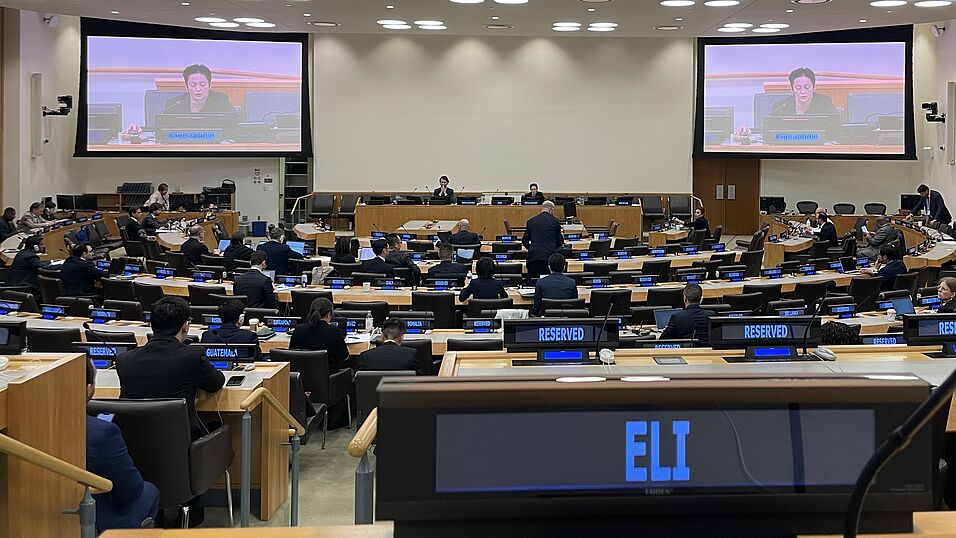
The ELI was represented by Prof em Dr Alexander Trunk (Kiel University, Germany), member of ELI and co-editor of a forthcoming book ‘EU International Insolvency Law and Third Countries: Which Way(s) Forward’.
The session was devoted to the project on applicable law in insolvency proceedings. The current text provides for Draft Model Law Provisions accompanied by a Guide to Enactment, which offers further commentary. The Draft Model Law sets out a body of rules on applicable law (conflict of laws rules and related provisions) intended to apply in insolvency proceedings or in the context of recognition of foreign proceedings. Similar to the European Insolvency Regulation (EIR 2015), the general rule on the governing law is the lex fori concursus.
The draft contains a limited number of specific safeguard provisions (on avoidance of transactions, set-off, the treatment of rights in rem and impact on foreign ‘individual’ proceedings) as well as general exceptions relating to labour contracts, clearing and settlement systems and close-out netting. Overall, the number of safeguard clauses and exceptions is smaller than in the EIR and may be of interest for discussions on future reform of the Regulation. A short provision addresses the specifics of concurrent or enterprise group proceedings. A brief separate chapter addresses conflict of laws in the context of recognition of (or other relief in support of) foreign insolvency proceeding, thereby linking the Draft Model Law with UNCITRAL’s Model Law on Cross-Border Insolvency of 1997.
The Working Group again devoted significant time to discussing the text, focussing mainly on the law applicable to avoidance of transactions, set-off, the impact on foreign proceedings, clearing and settlement systems. and close-out netting. Another subject of discussion was conflict of laws in the recognition of foreign proceedings. In this respect, the Draft Model Law provides a very soft conflicts rule (‘may’). Proposals by several delegations to introduce more specific guarantees remained controversial.
The Working Group’s meeting was preceded by an exchange of views at Brooklyn Law School on 12 April 2026, during which some new proposals that certain delegations intended to present at the Working Group meeting were discussed. During an informal meeting of delegations and observers between the formal sessions, possible amendments to the Guide to Enactment and – by way of a future work program – to the Legislative Guide on Insolvency Law were also considered. These included issues such as the treatment of digital assets in insolvency, the links between insolvency law and secured credit, and the rules applicable to rescue proceedings at the borderline of insolvency law.